
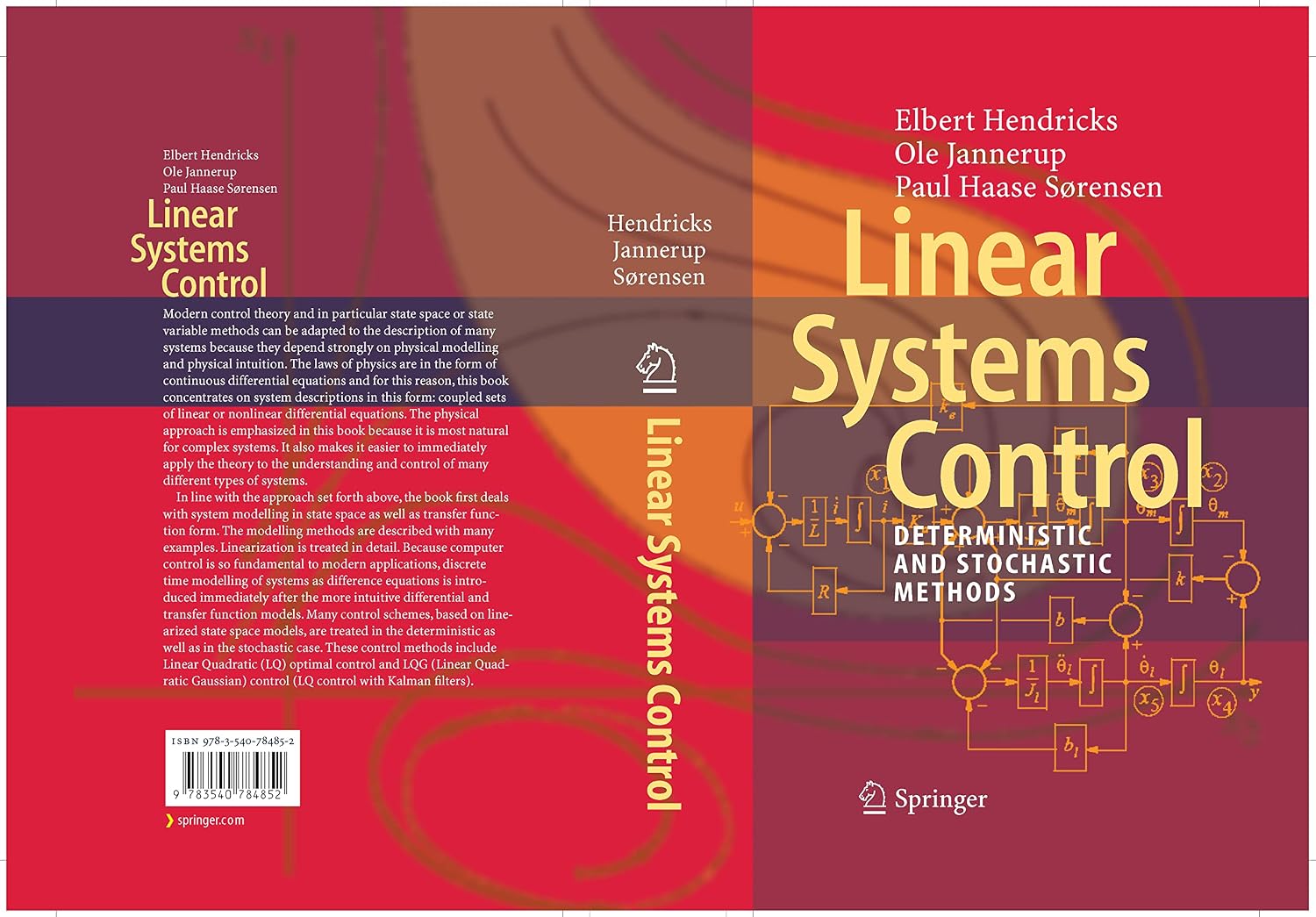
Linear Systems Control: Deterministic and Stochastic Methods
Product details
| Management number | 231883440 | Release Date | 2026/06/18 | List Price | US$56.05 | Model Number | 231883440 | ||
|---|---|---|---|---|---|---|---|---|---|
| Category | |||||||||
Modern control theory and in particular state space or state variable methods can be adapted to the description of many different systems because it depends strongly on physical modeling and physical intuition. The laws of physics are in the form of differential equations and for this reason, this book concentrates on system descriptions in this form. This means coupled systems of linear or nonlinear differential equations. The physical approach is emphasized in this book because it is most natural for complex systems. It also makes what would ordinarily be a difficult mathematical subject into one which can straightforwardly be understood intuitively and which deals with concepts which engineering and science students are already familiar. In this way it is easy to immediately apply the theory to the understanding and control of ordinary systems. Application engineers, working in industry, will also find this book interesting and useful for this reason. In line with the approach set forth above, the book first deals with the modeling of systems in state space form. Both transfer function and differential equation modeling methods are treated with many examples. Linearization is treated and explained first for very simple nonlinear systems and then more complex systems. Because computer control is so fundamental to modern applications, discrete time modeling of systems as difference equations is introduced immediately after the more intuitive differential equation models. The conversion of differential equation models to difference equations is also discussed at length, including transfer function formulations.A vital problem in modern control is how to treat noise in control systems. Nevertheless this question is rarely treated in many control system textbooks because it is considered to be too mathematical and too difficult in a second course on controls. In this textbook a simple physical approach is made to the description of noise and stochastic disturbances which is easy to understand and apply to common systems. This requires only a few fundamental statistical concepts which are given in a simple introduction which lead naturally to the fundamental noise propagation equation for dynamic systems, the Lyapunov equation. This equation is given and exemplified both in its continuous and discrete time versions.With the Lyapunov equation available to describe state noise propagation, it is a very small step to add the effect of measurements and measurement noise. This gives immediately the Riccati equation for optimal state estimators or Kalman filters. These important observers are derived and illustrated using simulations in terms which make them easy to understand and easy to apply to real systems. The use of LQR regulators with Kalman filters give LQG (Linear Quadratic Gaussian) regulators which are introduced at the end of the book. Another important subject which is introduced is the use of Kalman filters as parameter estimations for unknown parameters.The textbook is divided into 7 chapters, 5 appendices, a table of contents, a table of examples, extensive index and extensive list of references. Each chapter is provided with a summary of the main points covered and a set of problems relevant to the material in that chapter. Moreover each of the more advanced chapters (3 - 7) are provided with notes describing the history of the mathematical and technical problems which lead to the control theory presented in that chapter. Continuous time methods are the main focus in the book because these provide the most direct connection to physics. This physical foundation allows a logical presentation and gives a good intuitive feel for control system construction. Nevertheless strong attention is also given to discrete time systems.Very few proofs are included in the book but most of the important results are derived. This method of presentation makes the text very readable and gives a good foundation for reading more rigorous texts.A complete set of solutions is available for all of the problems in the text. In addition a set of longer exercises is available for use as Matlab/Simulink ‘laboratory exercises’ in connection with lectures. There is material of this kind for 12 such exercises and each exercise requires about 3 hours for its solution. Full written solutions of all these exercises are available. Read more
| ASIN | B0072CUF04 |
|---|---|
| XRay | Not Enabled |
| ISBN13 | 978-3540784869 |
| Edition | 2008th |
| Language | English |
| File size | 7.0 MB |
| Page Flip | Not Enabled |
| Publisher | Springer |
| Word Wise | Not Enabled |
| Print length | 575 pages |
| Accessibility | Learn more |
| Publication date | October 13, 2008 |
| Enhanced typesetting | Not Enabled |
Bestseller ranking
Robotics & Automation




Customers who viewed this product also viewed
Short Stories


Correction of product information
If you notice any omissions or errors in the product information on this page, please use the correction request form below.
Correction Request Form